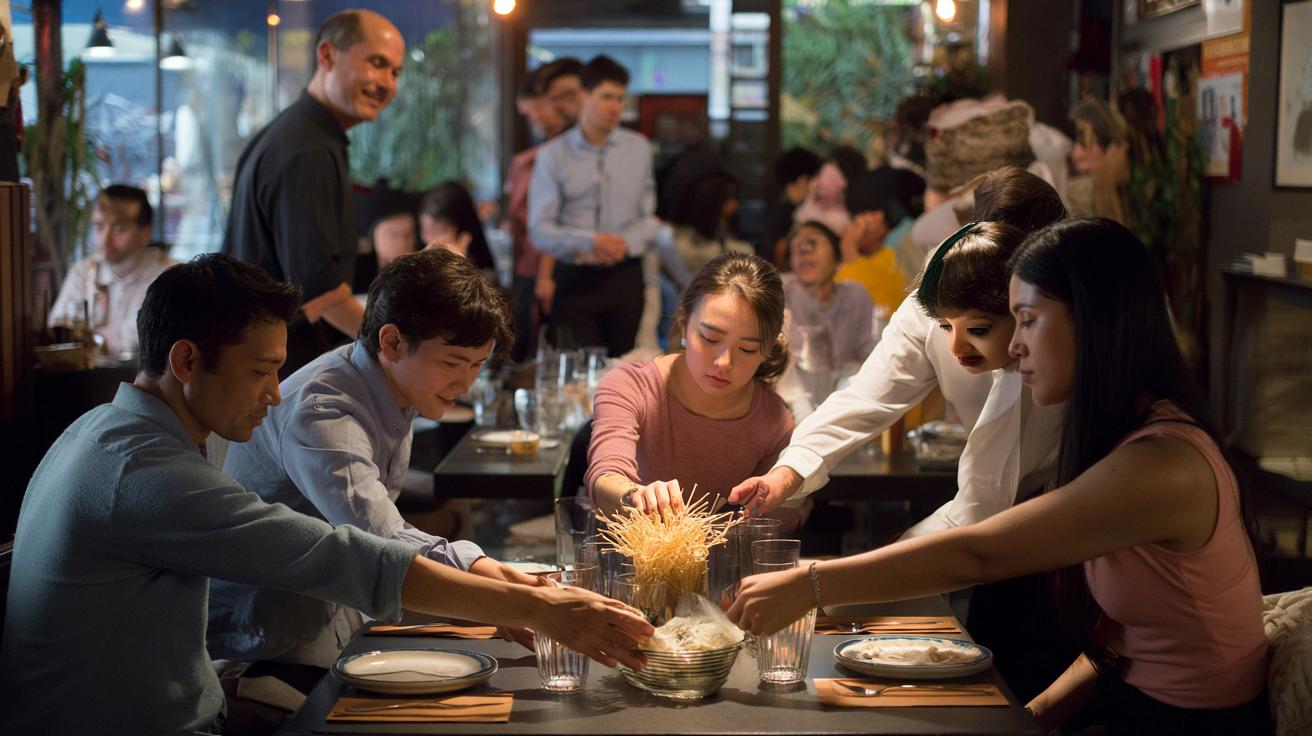
The other night in a busy bistro, a small scene stole the show from the food. At the table next to mine, a couple quietly stacked their plates, tucked used napkins into a bowl, lined up their glasses, and gently slid everything to the edge of the table. No drama, no big talk. Just a discreet, almost choreographed gesture while the rest of the room scrolled on their phones or waved for the bill.
The waiter arrived, paused for half a second, and smiled with real gratitude.
That tiny moment stayed with me.
Because people who do this — the ones who always tidy up after themselves in restaurants — often have something deeper going on. Something you don’t see at first glance.
Waarom sommige mensen in restaurants automatisch beginnen op te ruimen
Let’s be honest: most of us just push the plate a little forward and call it a day. So when someone neatly stacks the dishes, picks up the fallen straw wrapper, and wipes a small spill with a napkin, it stands out. This habit is rarely about being “perfectly polite”. It often reveals a whole inner world of values, reflexes, and invisible rules learned long ago.
Psychologists talk about “everyday pro‑social behavior”: small, voluntary acts that help others without any reward. Tidy‑uppers in restaurants score high on that. They don’t give a speech about respect for staff. They just move their hands and act.
Picture this: a family with two young kids leaves a pancake place. The table looks like a war zone — syrup trails, crayons, crumbs everywhere. Before the waiter can arrive, the mother quietly starts gathering napkins, stacking plates, sweeping crumbs into one spot with her hand. The father folds the kids’ drawings, slides everything to one edge, and even picks a fork up from the floor.
No one films it. No one claps. Yet you can clearly see a pattern. For many of these people, this behavior shows up at home, at work, on the train. They straighten chairs in meeting rooms, put back supermarket baskets, hold doors that others let slam shut. It’s rarely about perfectionism, more about an inner rule: “I don’t leave chaos behind for someone else.”
Psychologically, this gesture often mixes several traits. There’s conscientiousness — that tendency to anticipate the next step and smooth it out. There’s empathy: spontaneously picturing the tired waiter with twenty tables to clear. There’s also a strong sense of personal responsibility, almost like an allergy to the thought of being “that messy customer”.
Some researchers link this to what’s called an “internal locus of control”: the belief that your actions matter in the world. Even in a tiny scene like a café table, these people feel they have a role. *They can’t quite bring themselves to just walk away from a mini‑disaster when one small movement of the hand could change the picture.*
➡️ Mensen die vaak aan het verleden denken hebben volgens studies één belangrijk voordeel
➡️ Mensen die zich makkelijk dingen herinneren gebruiken bijna altijd deze techniek
➡️ Koude roodborstjes in de tuin: zet dit vandaag neer en ze komen elke ochtend trouw terug
➡️ Met zijn 80.000 ton wordt dit Franse vliegdekschip het grootste van Europa
Zeven opvallende persoonlijkheidskenmerken achter dit simpele gebaar
The first trait that often pops up is quiet empathy. People who clean their own table usually read the room quickly. They notice the overflowing tray in the waiter’s hand, the stress lines on the manager’s face, the bell of the kitchen ringing non‑stop. Their brain does a tiny calculation: “I can take ten seconds to make this easier for you.”
A second trait is foresight. They naturally anticipate the next step in the chain. They imagine how plates must be stacked, how sticky cups will travel back to the bar, how a table must be reset in record time. This doesn’t feel heavy or heroic to them. It’s just the way their mind works: always one half‑step ahead, always slightly tuned to someone else’s workload.
Then there’s the guest who used to work in hospitality. You can almost recognize them instantly. They move plates like a seasoned server, group cutlery by type, turn cups so the handles line up. Later they might laugh and say, “Sorry, once a waiter, always a waiter.” But behind the joke sits a deep trace: the memory of being invisible labor. Long shifts, aching feet, cleaning up messes customers never even saw.
This past experience often fuses with a third trait: strong fairness instinct. If they sense inequality — someone taking advantage because “that’s the staff’s job” — they feel a subtle sting. Their little tidying ritual is like a reply to that: a way of saying, silently, “I see your effort. I won’t dump everything on you.” That sense of justice can be stubborn, but it’s rarely loud.
A fourth trait is self‑discipline. Not the stiff, joy‑killing kind, but the steady habit‑muscle that kicks in even when nobody’s looking. These people don’t wait to be asked. They tidy as they go because it’s become part of their identity: “I’m someone who leaves things better than I found them.”
The fifth is social awareness. They know they’re in a shared space, not a private living room. That awareness keeps them from treating restaurants like disposable stages. Often there’s also a sixth trait hiding underneath: low entitlement. They don’t walk in thinking, “I pay, so I can do anything.” They see the exchange more like a partnership.
The seventh trait is subtle leadership. Not the bossy “I’ll show you how it’s done” style, but quiet modeling. One person at the table starts stacking plates, someone else automatically joins. No words. Just a small, contagious example set in motion.
Hoe je deze ‘restaurant-reflex’ zelf kunt ontwikkelen (zonder jezelf te verliezen)
If you feel a pull toward this behavior but don’t do it consistently yet, you can turn it into a light routine. Start small: when the bill comes, take ten seconds to group plates and put cutlery on top. Place all glasses together, napkins in one bowl or on one plate. That’s it. Ten seconds, one clear zone.
Next step: add a micro‑scan. Before you stand up, let your eyes travel over the table once. Is there a straw on the floor? A spilled sugar packet? Grab what you can reach without turning it into a full cleaning session. You’re not replacing the staff. You’re just softening the edges of the mess you created.
The big trap here is guilt. Some people, when they start doing this, feel they suddenly have to do it perfectly every single time. That’s a fast road to resentment. Maybe you’re exhausted, or you had a tough day, or you’re wrangling three kids at once. On those nights, you’ll leave more behind. That doesn’t cancel out all the other evenings.
There’s also the risk of judging others. Once you notice how “easy” it is to tidy a bit, you might side‑eye the table that leaves a mountain of fries under the chair. Breathe. You have no idea what kind of day they had. Your gesture stays cleanest when it’s about your values, not other people’s shortcomings.
“Every small act of consideration rewrites the script of who we are together,” notes a social psychologist who studies everyday kindness. “Most people underestimate how visible and impactful these tiny gestures really are.”
- Empathy in action: you picture the person who comes after you — the waiter, the cleaner, the next guest.
- Ten‑second habit: stack plates, group cutlery, collect napkins, slide everything to one edge.
- Healthy boundary: you help, but you don’t feel responsible for leaving a table spotless like a staff member.
- Occasional exception: tired nights, rushed lunches, bad days — you let it go without self‑attack.
- Silent ripple effect: your gesture sets a tone; people at your table often copy you without realizing.
Wat dit simpele gebaar zegt over hoe we samenleven
Once you start noticing who tidies their table in restaurants, you’ll see a quiet map of character spread out in front of you. It’s not an IQ test or a moral ranking. It’s more like a small window into how someone understands living together. Do they move through the world as if everything will be taken care of for them, or as if they have a tiny role in caring for shared spaces?
This doesn’t mean you should analyze every friend based on how they stack plates after sushi. Yet the pattern can spark honest reflection. Where do you leave small messes behind in your life, hoping someone else will handle them? And where do you naturally step in, unasked, because that’s who you are?
We’ve all been there, that moment when you stand up from a table and see the chaos you’re leaving behind. Some people sit back down for ten extra seconds and quietly change the ending of the scene. That choice, repeated over years, shapes not just your reputation, but your sense of who you are in the shared story of public life.
| Key point | Detail | Value for the reader |
|---|---|---|
| Empathy and foresight | People who tidy visualize the staff’s workload and the next steps after they leave | Helps you understand and strengthen your own pro‑social reflexes |
| Seven traits behind the habit | From fairness and low entitlement to subtle leadership and self‑discipline | Offers a mirror to recognize your strengths and blind spots |
| Simple 10‑second ritual | Stack plates, group cutlery, collect trash, slide to one side | Concrete, realistic way to act on your values in everyday life |
FAQ:
- Ruim ik het personeel niet “onderuit” als ik zelf opruim?Nee. Je neemt hun werk niet weg, je maakt één stap makkelijker. Zij blijven de tafel schoonmaken en resetten, jij haalt alleen de grootste chaos eruit.
- Moet ik dit in elk restaurant doen?Zeker niet. Zie het als een gewoonte die je vaak inzet, niet als een wet. Op drukke, vermoeiende dagen mag je deze reflex gerust loslaten.
- Is dit een vorm van controledrang of perfectionisme?Bij sommige mensen wel, maar vaker komt het uit empathie en verantwoordelijkheid. De vraag is: voelt het licht en vriendelijk, of gespannen en dwangmatig?
- Hoe kan ik mijn kinderen dit aanleren zonder streng te worden?Begin spelend: wie kan alle vorken op één bord leggen? Laat hen één taak doen en benoem zacht wat het anderen scheelt, in plaats van te mopperen op rommel.
- Maakt zo’n klein gebaar echt uit in het grote geheel?Ja, vooral omdat het zich verspreidt. Mensen aan jouw tafel en soms zelfs de bediening voelen het verschil en passen onbewust hun eigen gedrag aan.